
Contest #873 – Shepherd Mall, Oklahoma City, USA

What once was a thriving shopping mall built in the early 1960s found itself dying by the mid 1990s. The anchor stores had all left, and what was still around was mostly cafes, small independant stores, and a ton of empty space.
Then, at 9:02am on April 19th, 1995, the Alfred P. Murrah Federal Building in downtown Oklahoma City was bombed by domestic terrorists. 168 people were killed and another 680 injured. A third of the building collapsed within seconds of the blast.
The occupant agencies in that building had to go somewhere, and they found a willing and accomodating landlord in the management of Shepherd Mall. The empty stores were quickly converted into office space, and federal agencies moved in and were up and running in weeks. Secret Service, ATF, even Federal Court proceedings could be managed in the mall while plans were made to replace the federal building, which would take several years.
After the federal agencies moved out, the space was still available for state agencies, as well as commerical entities such as Insurance companies. This place, which had been destined for the wrecking ball before the bombing, was now thriving in a new life.
Those who found this site included:
- hhgygy
- Garfield
- Eloy Cano
- Paul Voestermans
- Martin de Bock
- Graham Hedley
- Phil Ower
- Lighthouse
And after the hint:
- Turriant
Contest #873 Hint
Was about to die then reborn in the flames of a terrorist bombing.
Contest #873

Contest #872 – Maw Tin Soon Pagoda, Pathein, Myanmar
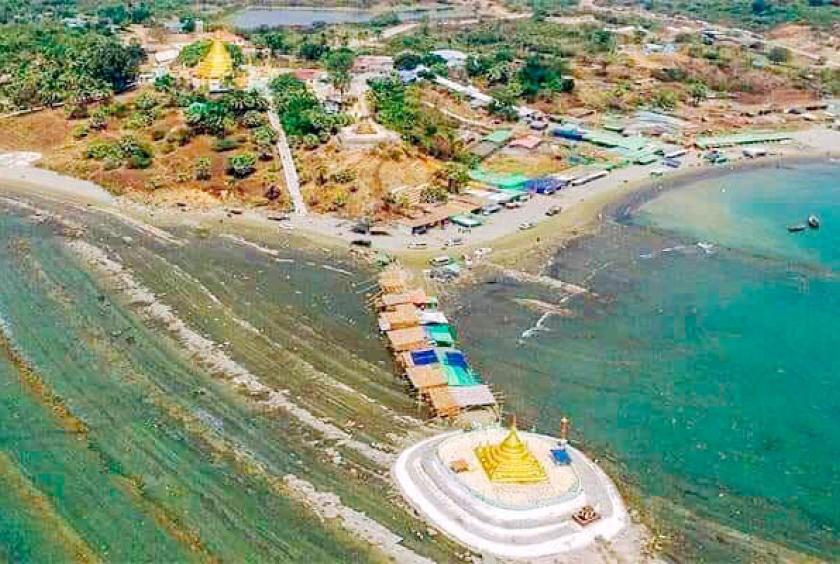
This Buddhist pagoda at the edge of the Andaman Sea is submerged for most of the year. During the festival month of Tabaung, the water level drops and the pagoda become accessable for pilgrims to journey to.
Those who found it before the hint:
- hhgygy
- Graham Hedley
- Martin de Bock
- Garfield
- Eloy Cano
- Paul Voestermans
- Phil Ower
- Bas van Limpt
- Angie CF
- Lighthouse
And after the hint:
- bernd
Contest #872 Hint
The part at the bottom is submerged underwater most of the year. When it emerges, there’s an 8-day long festival!
Contest #872

Contest #871 – Furnas Ibiúna substation, Ibiúna, Brazil
The third largest hydroelectric dam in the world is Itiapu on the border of Paraguay and Brazil. Each country gets half of the power, but since Paraguay uses a fraction of the power that Brazil does, they sell a big chunk of their share back to Brazil, but there’s a complication. Paraguay’s electric system runs on 50hz and the half of the generators at the dam that belong to Paraguay generate at that frequency. Brazil runs on 60hz and their generators generate at that frequency. So how do you get the part that Paraguay generates at 50hz to Brazil in a usable way.
That’s where Furnas Ibiúna substation comes in. At the dam, the part going to Brazil is converted to DC and sent down a couple of 800KM transmission lines which brings the power to this location. Once there, the power is converted back to AC, but at the 60hz frequency necessary for Brazilian use, and provided to the country’s grid.
You’ll note that this is a rare reveal without a picture. There wasn’t any that were particularly interesting or revealing.
Those who located this site before the hint:
- Martin de Bock
- Eloy Cano
- Garfield
- Phil Ower
- Paul Voestermans
- Angie CF
- hhgygy
- Lighthouse
and after the hint:
- Graham Hedley
- Bas van Limpt
Contest #871 Hint
This is the largest such facility in the world. 50 -> DC -> 60.
Contest #871
